


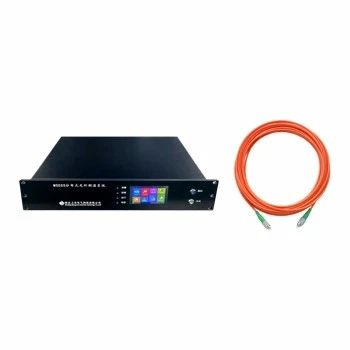

Products Description
Our fiber optic distributed temperature sensing system treats the sensing fiber as a continuous temperature sensor rather than a set of point probes. Three performance versions provide different spatial resolution and location accuracy.
Technical Principle
Dielectric optical probes are installed at the required hot spots. Temperature changes alter the optical response of the sensing material, and the monitor converts this response into a stable temperature value. Because the measuring path is optical rather than metallic, it remains suitable for strong electric and magnetic fields.

Product Features
The fiber optic distributed temperature sensing system provides continuous temperature coverage over kilometers of sensing fiber. Raman and OTDR processing locate each temperature event along the route. Three resolution levels support long routes or smaller hot-spot localization. The passive fiber is immune to electromagnetic interference and suited to hazardous areas.
Operating Conditions
Install the product in a clean, ventilated location without corrosive gas, conductive dust, water ingress, severe vibration, or strong impact. Provide reliable protective grounding, maintain the required electrical clearances, and use the rated auxiliary power supply. Confirm ambient temperature, humidity, altitude, enclosure protection, cable routing, and communication conditions before production and installation.

Product Parameters
|
Parameter |
Details |
|
Channels |
4 channels; optional expansion to 16 |
|
Measurement distance |
≤12 km |
|
Spatial resolution |
MSDSS01 ±0.4 m; MSDSS02 ±0.2 m; MSDSS03 ±0.1 m |
|
Location accuracy |
MSDSS01 ±0.4 m; MSDSS02 ±0.2 m; MSDSS03 ±0.1 m |
|
Alarm response / measurement time |
≤3 s / ≤1 s per km |
|
Temperature range |
-200°C to +455°C, depending on sensing cable |
|
Temperature accuracy / resolution |
±0.1°C under stated conditions / 0.01°C |
|
Interfaces |
RJ45, two RS485, two USB, and eight relays; up to 32 relays optional |
|
Power / consumption |
24 VDC; average ≤10 W |
|
Dimensions / weight |
430×346×90 mm / 8 kg |
Product Advantages
- The fiber optic distributed temperature sensing system provides continuous temperature coverage over kilometers of sensing fiber.
- Raman and OTDR processing locate each temperature event along the route.
- Three resolution levels support long routes or smaller hot-spot localization.
- The passive fiber is immune to electromagnetic interference and suited to hazardous areas.
Main Applications
The fiber optic distributed temperature sensing system is used for high-voltage cable routes, cable tunnels, joints, transport tunnels, tanks, conveyors, and dams.
It supports hot-spot warning, fire detection, current-capacity analysis, and route visualization.
The system is useful where many point sensors would be difficult to install and maintain.
Components
|
Part |
Function |
|
Distributed sensing host |
Launches optical pulses and calculates temperature and position. |
|
Temperature-sensing fiber |
Acts as the continuous passive sensing element. |
|
Relay and communication interfaces |
Send alarms and data to external systems. |
|
Web-based software |
Configures zones and displays maps, curves, history, and alarms. |
FAQ
Q: What information is needed for model selection?
A: Provide route length, zone plan, required spatial resolution, temperature range, fiber path, and interfaces.
Q: What should be checked before installation?
A: Check fiber bend radius, pulling force, connector cleanliness, route protection, and zone location records.
Q: How can the device or system be integrated?
A: Modbus RTU, Modbus TCP, JSON, and custom protocols are available in the stated platform.
Q: Which options should be confirmed before production?
A: Confirm performance version, channel count, sensing cable, connector, relays, networking, and backup battery.
Hot Tags: fiber optic distributed temperature sensing system, China fiber optic distributed temperature sensing system manufacturers, suppliers, factory, Cable Fault Location System, Cable Grounding Monitoring System, Cable Joint Fiber Optic Temperature Monitoring System, Cable Partial Discharge Online Monitoring System, Fiber Optic Distributed Temperature Sensing System, Overhead Line Fault Locator System


